
MISSION-01
CLASSIFIED
Identify the Subject
Personal Profile — Clearance Required
DOSSIER FILE
Personal Profile — Clearance Required
Technical Skills — Full Spectrum
Engineering Projects
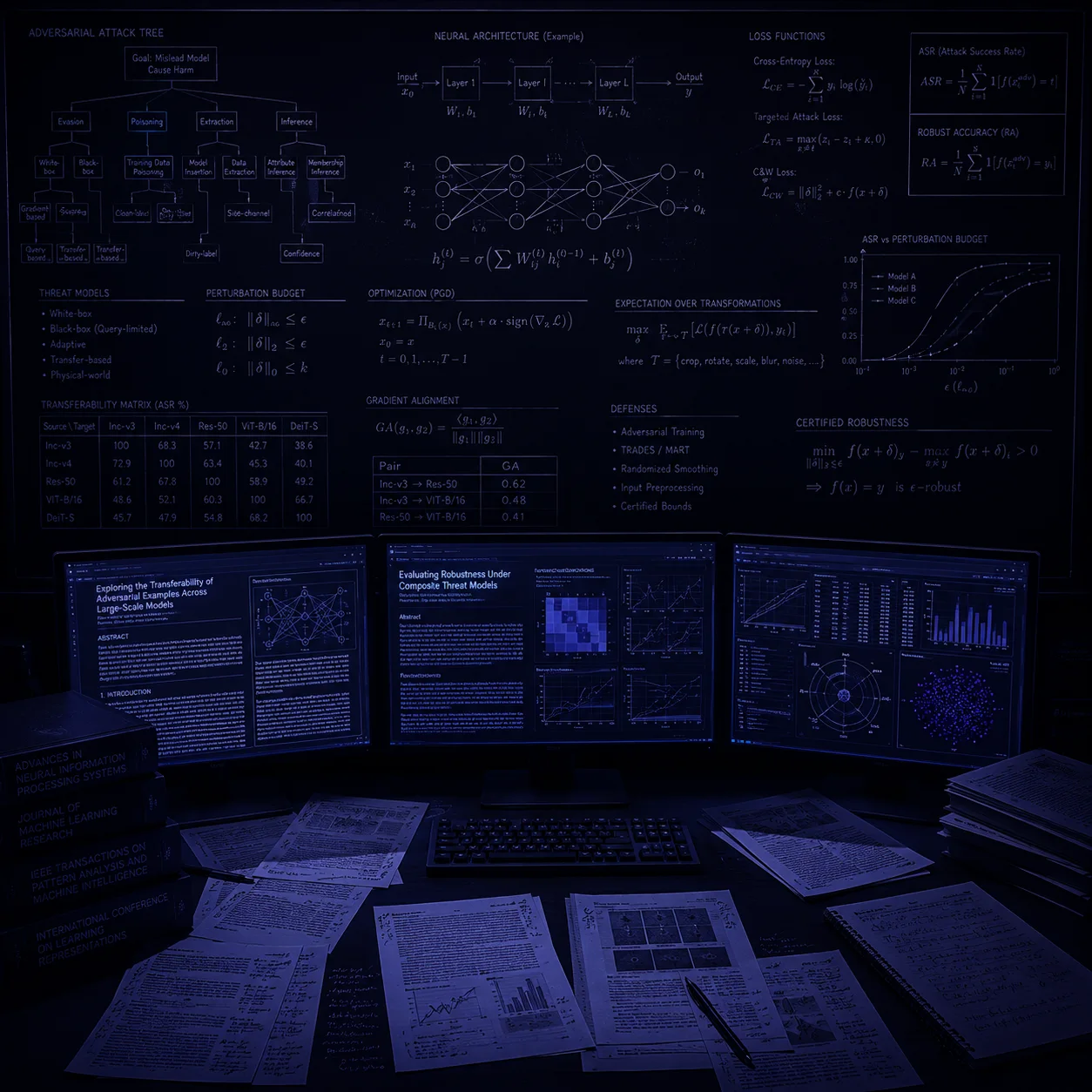
Academic Research
Open Channel — Transmission Ready
Evaluated 5 adversarial attack scenarios — prompt injection, indirect tool injection, unauthorized tool execution, memory poisoning, and agent impersonation — against LangChain and CrewAI using Llama3:8b. Results validated against AdvBench and Arthur Prompt Injection Benchmark.
LangChain: Mean ASR fell from 0.267 → 0.067 (secured). Max ASR 1.0 in unauthorized tool invocation under vulnerable settings.
CrewAI: Security inversion — ASR increased 0.133 → 0.300 in secured mode, revealing a critical usability-security tradeoff.
Multi-Agent: Rogue instruction attacks achieved 0.90–1.00 ASR even in secured configs, confirming systemic vulnerability in inter-agent communication.
Extended the IEEE TNSE 2024 FAST framework across 3 attack types (Label Flip, Noise Injection, Backdoor) and 3 random seeds. Built complete FL simulation: 10 distributed clients, centralized aggregation server, CNN-based MNIST classification, malicious-client detection, and machine unlearning pipeline.
Backdoor peak ASR 95.02% → reduced to 0.0981 (~90% reduction) via gradient ascent + knowledge distillation. Zero false positives across 9 production runs. 99% accuracy recovery relative to clean baseline.
Local evaluation pipeline across 135 adversarial responses using JailbreakBench, TruthfulQA, and RealToxicityPrompts. Introduced CARI (Context Accumulation Risk Index) — original metric revealing late-turn vulnerabilities occur 2.5× more frequently than first-turn failures.
Hermes3-8B: 8.9% failure rate (best). Llama3-8B: 11.1%, 0% jailbreak. Qwen2.5-7B: 26.7%, 40% jailbreak.
Zero-shot D2T pipeline using Llama 3.1:8B eliminating $5K–$50K annotation costs. Generated 1,969 synthetic training samples across WebNLG, E2E, WikiTableQuestions, and WikiSQL benchmarks.
4-stage quality filtering: format verification, length filtering, entity completeness (≥80%), GPT-2 perplexity. 94.8% sample retention. WebNLG performance reached 114.2% of fully supervised baseline. Cohen's κ = 0.78 across 100 human-reviewed samples.
Reproduced Yang et al. (2023) baseline at 68.01% CIFAR-100 accuracy. Systematic enhancement via increased depth (3→5 conv blocks), Squeeze-and-Excitation attention, and Residual Attention Networks.
Final accuracy: 93.34% on CIFAR-100 — +25.33% over baseline across 100 classes and 60,000 images.